
In Part 2 of our utility bill design series, we’ll show you how the right fonts, data visualizations, and other essential elements reduce customer service calls while speeding up payment rates.
Fonts and font sizes in utility bill design
Utility bills are information-dense documents. Typography is a crucial element which guides the eye towards important details. And font selection directly impacts utility bill readability and customer comprehension.
Choose sans serif fonts (Arial, Helvetica, Calibri, Open Sans) which are clean and easily readable. Avoid decorative or script fonts.
Best practice: Use a single font family for body text, with bold formatting for emphasis. More than two different fonts create visual noise and make the document harder to scan.
Make sure type size and weight correspond to importance so your invoice is easy for your customer to review.
| Element | Size | Weight |
| Headers (Company Name, Bill Title) | 14-18 pt | Bold |
| Body Text (Addresses, Bill Details) | 12 pt | Regular |
| Payment Details (Totals, Due Dates) | 14-18 pt | Bold |
| Fine Print (Terms, Instructions, Messages) | 8-10 pt | Regular |
It’s not about aesthetics—it’s about ensuring customers can quickly find and read the most important information on their utility statement.
Data visualizations for instant insight
Seeing a visual conveys meaning immediately. Charts and graphs transform raw usage data into insights customers can actually understand and act on. Here are a few examples of visual elements that can be incorporated into your utility bill.
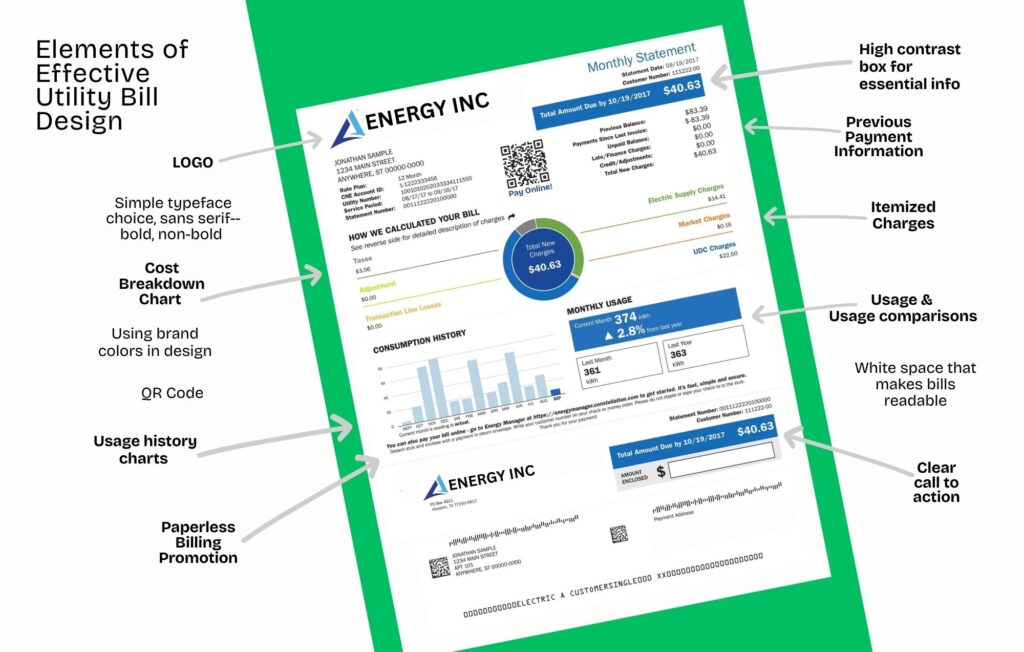
Usage comparison charts showing current month vs. last year’s same month help customers contextualize their consumption. A simple bar chart or line graph answers “Is this normal?” at a glance. Add a trend line showing the past 12 months to reveal patterns.
Cost breakdown charts provide a visual of total charges by category. Customers see where their money goes. Reduces “why is my bill so high?” calls.
Benchmark comparisons engage customers. “You used 18% less energy than similar homes in your area” or “you used 2.5% less energy this month” motivates conservation better than raw kilowatt-hour numbers.
Include brand elements in your utility bill
Your utility bill is a monthly touchpoint for your company and brand. Unlike marketing materials customers might ignore, your bill gets opened, read, and kept on file. This makes it a powerful branding opportunity.
Place your logo in the same position on every bill—typically top left or top center. The logo doesn’t need to dominate the page; it just needs to be recognizable. Maintain the same layout structure month after month.
Apply brand colors to highlight key elements throughout the design, such as payment boxes and important headings.
Other useful content elements
Additional elements for effective utility bills:
Itemized Charges: Break down total amount into components—base service, usage charges, taxes, fees. Transparency builds trust and reduces customer service inquiries.
Previous Payment Information: Show last payment date and amount, past due amounts. This helps customers verify their payments were received.
QR Code: Provides access utility bills online to allow customers to make payments instantly.
Contact Information: List multiple support channels—phone numbers with hours, website, email, physical office locations. Make it easy for customers to reach you however they prefer.
Paperless Billing Promotion: Highlight electronic billing with a clear call-to-action: “Switch to paperless at [URL].”
Make it easy for your customers
Your utility bill is your most frequent customer touchpoint—make it count.
Effective utility bill design combines smart typography, meaningful data visualization, consistent branding, and complete information—all working in service of customer understanding and timely payment.
Ready to redesign your utility bills? Metro Presort offers utility bill design consultation alongside our utility bill printing and presort mailing services. Contact us today, and let’s create effective utility statements and transactional mail that benefit both your customers and your organization.