
It’s 2026. And it’s set to be the midterm to beat all spending records, with down-ballot spending alone breaking records.
AdImpact’s “Updated Political Projections Report,” published June 11, 2026 indicates that $11.6 billion in political advertising will be spent nationally, outpacing even the 2024 presidential race.
In Oregon, that pressure is local: a tightening governor’s race, a marquee 5th District contest, and four open state Senate seats mean more competitive mail programs than usual — all funneling through the same tight August-to-November production window.
This guide is for campaign managers navigating that early window of decisions. And how the right print partner can help guide every step, from design and format choices and printing to political mailings strategy and on-time delivery.
Political Direct Mail: Trusted by Voters. Proven to Persuade.
A new joint study from the U.S. Postal Service and the American Association of Political Consultants, drawing on more than 1,800 surveyed voters across 2025 gubernatorial and mayoral races, makes the case plainly: 67% of surveyed voters said direct mail impacted their opinion of a candidate this cycle — up from 51% just one year earlier.
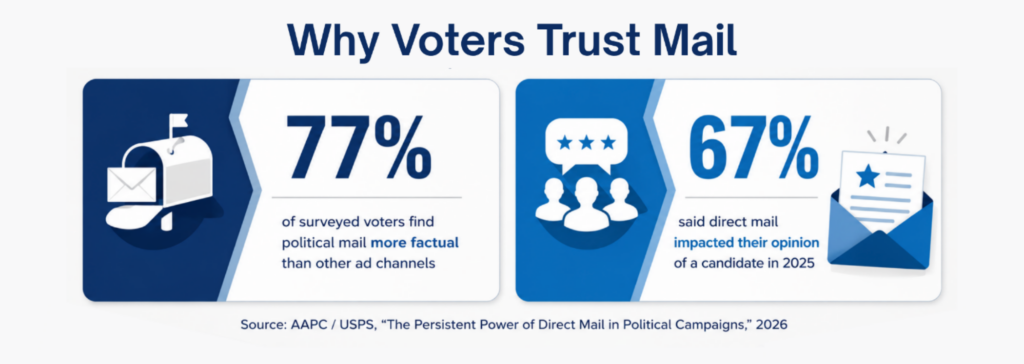
Printed campaign materials continue to be one of the most trusted ways to communicate with voters. In an environment where misinformation spreads easily online, voters uniformly view direct mail as a more reliable source of campaign communication.
Choose the Right Size for Maximum Voter Impact
Different campaign messages call for different mail formats. With decades of direct mail experience, Metro Presort can help you select the format that delivers the greatest impact for every phase of your campaign.
LARGE POSTCARD
6 x 9 – Candidate introduction, issue messaging, persuasion, fundraising
OVERSIZED POSTCARD
6 x 11 – High-impact persuasion, comparison pieces, final GOTV
JUMBO POSTCARD
8.5 x 11 – Candidate introduction, issue messaging, persuasion, fundraising
FOLDED SELF-MAILER
8.5 x 11 folded to 5.5 x 8.5 – Space for issues, endorsements, voting information
LARGE FOLDED SELF-MAILER
11 x 17 folded – Legislative races, judicial campaigns, county races
Choose the Right Paper Stock for Political Mailings
There are a large variety of paper and finish choices for political mailings. Here’s a quick guide to the most common options and when to use them. Choosing paper stock and finishes doesn’t have to be complicated. Your print partner can guide you to the right print combination for your campaign, budget, and timeline.
- 100 lb Gloss Cover – The industry standard for most political postcards. Durable, economical, and provides vibrant color reproduction for candidate photos and campaign graphics.
- 14 pt Cover Stock – A heavier postcard that feels more substantial in the voter’s hand while remaining cost-effective for most campaigns.
- 16 pt Premium Cover – A thicker, high-impact stock often reserved for persuasion pieces, comparison mailers, and final GOTV drops where standing out in the mailbox matters.
- Gloss Finish – The most popular choice for political mail. Bright colors, sharp images, and a polished appearance.
- Matte Finish – Reduces glare and creates a more understated, premium look. Often chosen for judicial, nonprofit, or issue advocacy campaigns.
- Aqueous Coating – A water-based protective coating that helps postcards resist scuffing during USPS processing while maintaining a natural feel.
- UV Coating – A high-gloss protective finish that makes colors pop and adds extra durability, often used for premium campaign pieces.
Plan Your Political Mailings Calendar Early
The most successful campaigns don’t plan one mail piece at a time—they map out the entire mail program before the first piece goes to press. If you’re planning a typical seven-piece campaign, meet with your print and mail partner early to establish target in-home dates for every mailing.
Working backward from Election Day gives your team time for writing, design, approvals, printing, postal processing, and delivery—while reducing last-minute stress and costly rush charges.
The 7-piece Political Mail Sequence That Moves Voters
Mailer #1 Candidate Introduction
Introduce the candidate, share their background, values, and why they’re running.
Mailer #2 Issue Mailer
Communicate positions on the issues that matter most to voters.
Mailer #3 Endorsement Mailer
Highlights endorsements from respected community leaders, organizations, media.
Mailer #4 Persuasion / Contrast Mailer
Differentiates your candidate by drawing clear contrasts with the opponent.
Mailer #5 Vote-by-Mail Mailer
Encourages supporters to request, complete, and return their mail ballot; vote early.
Mailer #6 Early Voting Mailer
Promotes early voting dates, locations, and hours.
Mailer #7 Get Out The Vote (GOTV)
A final, high-urgency reminder: Election Day details, polling information, and call to vote.
Your Print Partner Can Be One of Your Biggest Campaign Assets
Political mail moves fast—and there are a lot of moving parts. Think of your printer as an extension of your campaign team. Metro Presort can plan and coordinate your campaign mail calendar, recommend formats and paper stocks, coordinate design and production, manage mailing lists, qualify your mail for USPS postage discounts, and oversee every mailing from concept to mailbox.
Ready to plan your campaign mail?
As political spending reaches record levels, the campaigns that plan early will have the advantage. From the first introduction mailer to the final GOTV piece, Metro Presort can help you develop a mailing strategy that keeps your campaign on schedule, on budget, and in voters’ hands when it counts most.
Contact Metro Presort for a free consultation and start building a campaign mail calendar that delivers your message to voters.