
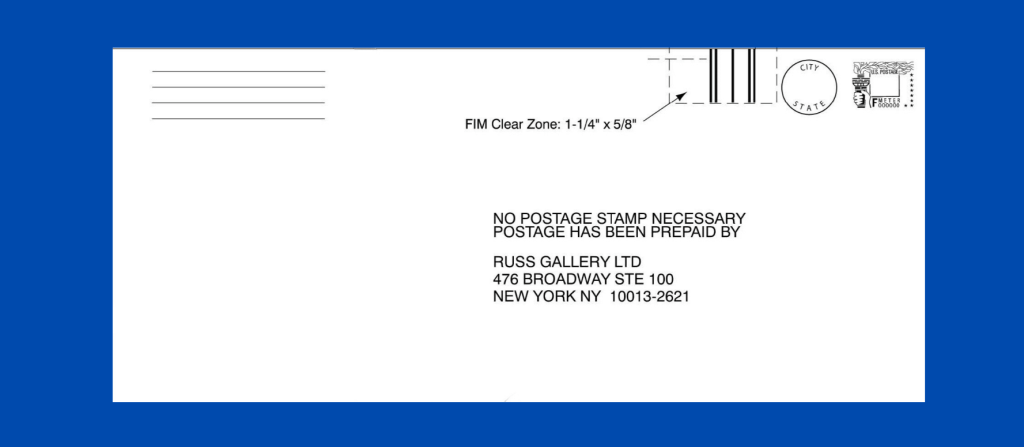
Have you ever wondered about those little marks that you sometimes see at the top of an envelope? They look like this:
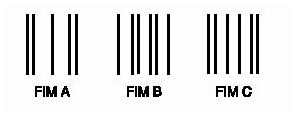
The answer – they are FIM Marks.
What is a FIM Mark
A “FIM mark” (Facing Identification Mark) in mailing is a series of vertical bars printed on the upper right of an envelope used by automated postal equipment to orient mail for processing and identify specific mail types, such as business reply mail. These marks tell the mail-sorting machines how to process the piece, and depending on the pattern (A, B, C, or D), they indicate postage payment method, preprinted barcodes, and other information.
There are different FIM Marks for different purposes, but each FIM uses the same design across the U.S. Having the FIM doesn’t necessarily speed up delivery, but it allows the mail piece to skip some processing and reduces the number of damaged pieces. The delivery standard is the same – it’s not better or worse with or without the FIM.
Mailing Applications for FIM
The FIM is used exclusively for envelopes, only to be applied to letter mail. They are not used on shipping labels. The USPS equipment that processes flats and packages does not look for a FIM.
The USPS equipment used to process mail gathers two key pieces of information about each envelope. First, it alerts the machine to the type of postage that is (or should be) affixed to the piece. Second, it tells the machine whether the mail piece already has an Intelligent Mail barcode with the delivery ZIP+4.
The Common FIM Marks (A, B, & C)
The FIM A is used to designate an envelope that has an Intelligent Mail barcode and should have a conventional stamp or a red postage meter ink mark applied. Conventional stamps contain an invisible phosphorescent ink, while red postage meter ink contains a red fluorescent trace. Both materials, when viewed with a short-wave light source, emit a green or red signal that can be detected by a USPS machine called a Facer Canceller.
The pre-addressed envelope you receive from your water or credit card company typically has a FIM A. This type of envelope is called a courtesy reply envelope. The recipient is expected to place their payment in that envelope, affix a stamp or postage meter mark, and drop it in the mailbox. The billing entity benefits from a pre-addressed envelope that delivers their money to them more quickly.
A FIM C is used for Business Reply mail. This tells the USPS Facer Canceller that the mail piece contains an Intelligent Mail barcode, but that there will be no fluorescent ink to detect. In this case, the postage is paid by the recipient of the mail through a permit billing system. The original mailing organization is only billed for the postcards sent back to them. This application is often used as Business Reply postcards in magazines, catalogs or other brand marketing collateral.
A FIM B is used for Business Reply mail without an Intelligent Mail barcode. Because the USPS charges much more to the permit holder to process non-Intelligent Mail encoded reply mail, this is rarely the case.
How Today’s Technologies Impact Successful Mailings
Mailings have evolved, and as a result, can incur extra expense and slower delivery times without the proper application of USPS-approved technologies available today. Following are a few examples for consideration:
- Handwritten Envelope with Conventional Stamp
Envelopes personally addressed by hand can not use an FIM, so the facer-canceller will look for the phosphorescent trace of the stamp (or the fluorescence of the meter mark) as evidence of postage payment. Note that this process can’t detect the value of the stamp or meter mark, only if one is present. - Mortgage Payment Envelope with a FIM A and Conventional Stamp
The facer-canceller will see the FIM A and know that the POSTNET barcode is already assigned to this envelope. Provided there is a stamp or meter mark on the envelope, it will end up in the FIM A bin. Envelopes in the FIM A bin immediately go to the Intelligent Mail barcode sorters, which segregate the mail by destination city or geographic region. This sorted mail is then loaded on the trucks and aircraft immediately. - Postage Envelope with FIM D
This envelope will be handled in much the same way as the FIM A example above. The FIM D will alert the facer-canceller that the envelope contains neither phosphorescence nor fluorescence, so this check will be skipped and the envelope will discharge into a bin immediately that then goes to the barcode sorter and is loaded onto outbound transportation. - Envelopes Printed Directly from a Computer
The facer canceller will look for the fluorescent stamp or meter ink, while the Wide Field of View (WFOV) cameras identify if the envelope is handwritten or printed from a computer. If it makes the determination that it is printed, it will discharge the envelope into yet another bin. Mail in this bin is then taken to a machine called the Optical Character Reader or OCR. This machine uses a computer to scan the address and convert the scan to characters. It then looks up the proper ZIP+4 for this address (if possible) and then sprays the Intelligent Mail barcode on the lower right corner of the envelope.
Today’s technology and scanning machines work quickly, but does add an extra step to the mail processing before envelopes can go to the final barcode sorting machine, which can cause delays in delivery.
The team at Metro Presort are here to consult, help design, produce and deliver your mail keeping in mind your audience, budget and timing while adhering to postal requirements.